
By E-commerce 4 Internet Marketers Editorial
High-risk WooCommerce stores attract more than ordinary catalog browsing. Card testing, stolen admin credentials, abandoned plugins, and live payment keys copied onto staging all show up as failed orders, chargebacks, or a quiet takeover of wp-admin. WordPress.org's Hardening WordPress guide frames security as risk reduction across access limits, containment, backups, and trusted sources. For merchants who sell regulated or higher-risk products, those controls matter most where money moves: checkout endpoints, privileged accounts, plugin attack surface, edge filtering, and payment credentials that must never leak from staging into production.
This explainer is a practical hardening map for website owners and developers. It is not underwriting advice, a PCI assessment, or a substitute for your host, gateway, or Qualified Security Assessor.
Treat checkout endpoints as a fraud and abuse surface
WooCommerce's Store API is the machine path behind the Checkout block and several express payment flows. Official Store API docs require a Nonce header or Cart Token for checkout requests, and they state that nonces must be created with wp_create_nonce( 'wc_store_api' ). WooCommerce also documents a development-only filter, woocommerce_store_api_disable_nonce_check, and warns that it must not be enabled in production.
Card testing is the abuse pattern that maps onto those endpoints. In a December 18, 2024 developer blog post, WooCommerce describes attackers placing small purchases to validate stolen cards, including attacks aimed at the Store API without the Checkout block. WooCommerce lists rate limiting and CAPTCHA that actually protect Store API checkout as primary mitigations, and it notes that some CAPTCHA plugins previously failed to cover Checkout block or Store API submissions until patched.
Enable checkout rate limiting in WooCommerce → Settings → Advanced Features under "Rate limiting Checkout block and Store API." WooCommerce's rate-limiting docs say that UI toggle applies only to POST /checkout and the Place Order flow, at a maximum of 3 requests per 60 seconds. Broader Store API rate limiting remains opt-in through woocommerce_store_api_rate_limit_options (default off, default 25 requests per 10 seconds when enabled). If the store sits behind a proxy or CDN, enable proxy support so limits key on forwarded client IPs instead of the edge IP. WooCommerce 9.8 also adds woocommerce_store_api_rate_limit_id so developers can fingerprint beyond raw IP when attackers rotate addresses.
Separately, WooCommerce's July 30, 2026 security guidance tells operators to baseline normal daily order volume, failed orders, refunds, and average order value, then watch Analytics → Orders for unexplained spikes of small orders (possible card testing), sudden drops in completed orders, and unusual refund activity. Those signals are how checkout abuse shows up before a malware scanner fires.
Enforce admin MFA and close credential side doors
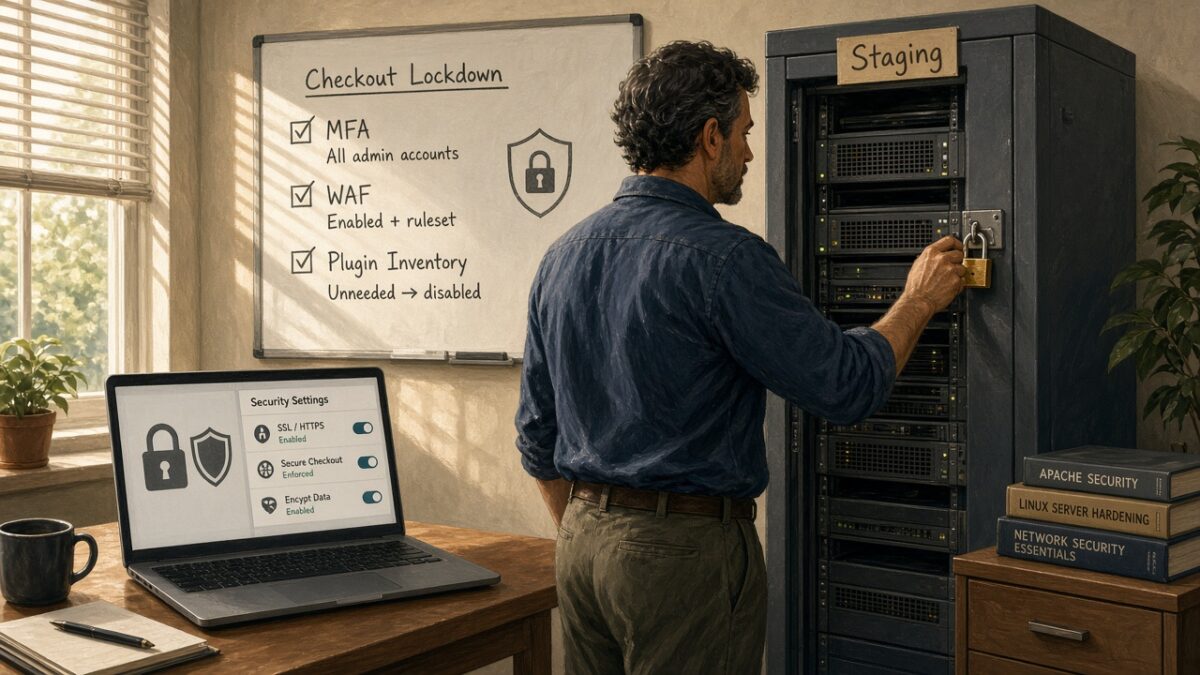
WordPress.org's hardening guide says a strong password is necessary because an attacker with administrator access can install malicious scripts that compromise the server, and it recommends enabling two-step authentication as an additional measure. The Advanced Administration Handbook page on Two Step Authentication explains that passwords alone are a single knowledge factor and that two-step systems add a possession factor such as a phone or authenticator. WooCommerce's own security checklist tells store teams to require two-factor authentication for Administrators after auditing users and lowering privileges.
Force admin and login sessions over HTTPS with FORCE_SSL_ADMIN in wp-config.php, as documented in WordPress's Administration Over SSL guide. Pair that with define( 'DISALLOW_FILE_EDIT', true ); so a stolen admin session cannot edit plugin or theme PHP from the Dashboard, another hardening control WordPress documents explicitly.
Also inventory Application Passwords and WooCommerce REST API keys. WordPress documents Application Passwords as revocable credentials for programmatic access over HTTPS Basic Auth, intended for integrations rather than interactive browser logins. WooCommerce's security post tells operators to open WooCommerce → Settings → Advanced → REST API, remove unused keys, and audit keys with read/write access. Any automated credential path that can place or manage orders belongs on the same least-privilege and rotation schedule as human admins.
Shrink the plugin and theme inventory
WordPress.org's hardening guidance is blunt on plugins. Keep them updated. If you are not using a plugin, delete it. Restrict installs to the WordPress.org repository or well-known companies, and treat write-access or arbitrary-code plugins as containment risks because they magnify damage after a successful attack.
For a high-risk checkout, that inventory pass should include payment gateways, fraud tools, CAPTCHA, page builders that inject checkout scripts, abandoned "temporary" MU-plugins, and any extension that can edit orders or export customers. WooCommerce's security article also tells teams to look for unexpected plugins or themes in the dashboard and to review WooCommerce → Status → Logs for services that should no longer pull data from the site.
Containment still applies after the inventory. WordPress recommends locking file permissions so core, wp-admin, wp-includes, and plugin directories are not writable by the web server when write access is unnecessary, keeping writable areas limited to the content paths that truly need them.
Put WAF and edge rules in front of login and checkout
WordPress.org lists several firewall layers. Application firewall plugins can filter at .htaccess or during WordPress load. Server-level options include ModSecurity. Reverse-proxy WAFs and CDNs such as Cloudflare, Sucuri, and Incapsula sit in DNS so malicious requests can be stripped before they reach PHP. Those product names appear in WordPress's own hardening article as examples of the pattern, not as endorsements of a single vendor.
For high-risk WooCommerce, map WAF or edge rules to the surfaces attackers actually hit:
- Login and
xmlrpc.phpbrute force paths called out in WordPress security materials. POSTtraffic to Store API checkout (/wp-json/wc/store/v1/checkout) and classic checkout AJAX where still used.- Sudden bursts of failed payment attempts that match card-testing velocity.
- Admin paths that should only be reachable from known office or VPN networks when operationally feasible.
WAF rules complement, and do not replace, WooCommerce's built-in checkout rate limit or a CAPTCHA that validates on the Store API authentication path. WooCommerce's card-testing post is explicit that rate limiting slows attacks but does not fully stop rotating-IP campaigns, which is why edge filtering, gateway fraud tools, and failed-order monitoring belong in the same stack.
Keep staging payment credentials out of production
Cloning production into staging is a common way live gateway keys end up on a disposable URL. WooCommerce documents safer patterns.
For WooPayments, test accounts create a dedicated simulated account without real business details or live money. On development or staging sites, WooPayments only allows test accounts when environment constants such as WP_ENVIRONMENT_TYPE set to development or staging, WP_DEVELOPMENT_MODE, WCPAY_DEV_MODE, or the wcpay_dev_mode filter put the site into developer mode. WooPayments Safe Mode triggers when a site address changes after a clone. For a new staging URL, WooCommerce says creating a fresh connection is usually correct so staging can use a test account while production keeps its live connection.
For Authorize.Net via WooCommerce's official extension, the Environment setting switches between Sandbox and Production credentials. WooCommerce's docs state that Sandbox is an entirely separate environment with a separate login and separate API credentials, and that it is not the same as flipping "Test Mode" inside an Authorize.Net control panel (which can stop transactions from processing). The extension also requires SSL even on local test environments.
Operational rules that follow from those docs:
- Give staging its own sandbox or test credentials. Do not paste production API Login IDs, transaction keys, or live WooPayments connections into disposable hosts.
- After a clone, resolve Safe Mode deliberately. Prefer a fresh staging connection over transferring the live account to a staging hostname.
- Keep debug logging for payment plugins off unless you are actively troubleshooting, as WooCommerce's Authorize.Net guide advises.
- Rotate any production key that may have been copied into staging, tickets, or backups once the leak path is closed.
A one-week hardening pass for operators
- Confirm Store API nonce checks are intact in production and enable the Checkout block and Store API rate-limit feature.
- Enforce MFA for Administrator and Shop Manager roles, force SSL admin, and disable Dashboard file editing.
- Delete unused plugins and themes, update what remains, and revoke stale WooCommerce REST API keys and Application Passwords.
- Place or tune a WAF or CDN layer in front of login and checkout, with proxy-aware rate limits where applicable.
- Rebuild staging payment config on sandbox or WooPayments test credentials, and verify production no longer shares those secrets.
- Baseline order, failure, and refund metrics so card-testing spikes are visible in WooCommerce Analytics and gateway dashboards.
Website owners and developers selling regulated products do not need a perfect fortress. They need fewer admin entry points, a checkout path that resists automated card testing, an edge filter that drops obvious abuse before PHP runs, and payment credentials that never travel with a staging clone.