
By E-commerce 4 Internet Marketers Editorial
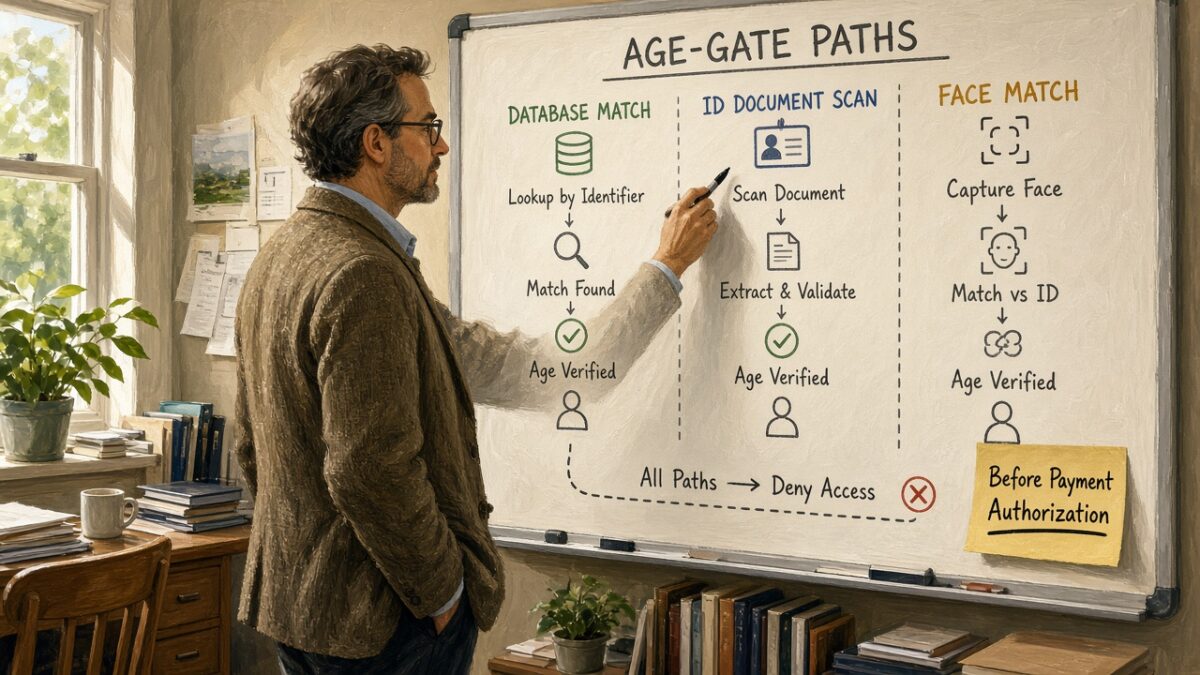
Explainer. Checkbox “I am 21” prompts do not meet the federal delivery-sale age rules that apply to cigarettes, smokeless tobacco, and electronic nicotine delivery systems (ENDS), and they increasingly fail underwriting expectations for other adult-restricted carts. This article compares three technical age-gate families (commercial database match, government ID-document proofing, and face analysis) and shows where each belongs in checkout relative to payment authorization. Primary sources are 15 U.S.C. § 376a (PACT Act delivery-sale rules), 15 U.S.C. 375 (definitions, including ENDS), the Bureau of Alcohol, Tobacco, Firearms and Explosives (ATF) Prevent All Cigarette Trafficking (PACT) Act overview, ATF Tobacco Sellers Reporting, Shipping and Tax Compliance Requirements, FDA Tobacco 21, 21 CFR 1140.14, NIST IR 8525 (face age estimation and verification), the NIST FATE Age Estimation & Verification program page, and NIST SP 800-63A (identity proofing). This is not legal advice. Confirm product-specific rules with counsel.
Why architecture beats a homepage popup
Age assurance for regulated carts is an order-lifecycle control, not a theme decoration. A JavaScript entry popup can be closed, blocked, or skipped via deep links and express checkout. Payment authorization that succeeds before a server-side age decision creates a completed (or authorizable) sale that then needs void, refund, or fulfillment hold. For tobacco delivery sales, federal law is explicit about sequence. Under 15 U.S.C. § 376a(b)(4)(A)(iii), a delivery seller shall not accept a delivery sale order from a person without obtaining that person’s full name, birth date, and residential address, and verifying that information through a commercially available database (or aggregate of databases) consisting primarily of data from government sources and regularly used for age and identity verification. That verification is a precondition to accepting the order, not a post-auth afterthought.
FDA’s Tobacco 21 page states that since December 20, 2019 it has been illegal for a retailer to sell any tobacco product, including e-cigarettes, to anyone under 21, with no federal carve-outs. 21 CFR 1140.14 requires retailers not to sell cigarettes, smokeless tobacco, or covered tobacco products to persons younger than 21, and (with stated exceptions for persons over age 29) to verify age by photographic identification containing the bearer’s date of birth. Remote carts cannot treat a checkbox as that photo-ID check.
CBD and hemp storefronts sit in a different federal posture. This article does not invent destination-state minimum ages or claim a PACT-style national database mandate for hemp SKUs. Destination law, platform policy, and acquirer underwriting still drive age gates for many CBD and adult-restricted catalogs. The engineering pattern is the same. Tag regulated SKUs, choose a method that matches the risk and legal trigger, and refuse payment authorization until a server-validated attestation exists on the cart or order.
Method 1. Commercial database age and identity match
What it is. The buyer supplies full name, date of birth, and residential address. The merchant (or a processor acting for the merchant) queries an independent commercial database built primarily from government sources. The database returns a match or mismatch against age and identity attributes. 15 U.S.C. § 376a(b)(4)(B) adds a hard constraint for tobacco delivery sales. The database used for that verification shall not be in the possession or under the control of the delivery seller, and shall not be subject to changes or supplementation by the delivery seller.
Where PACT places it. ATF’s compliance materials and the statute both treat database verification as part of accepting the remote order. Separately, § 376a(b)(4)(A)(ii) requires a shipping method that obtains an adult signature at delivery and requires the signer to present a valid government-issued photo ID proving the minimum age at the place of delivery. Checkout database checks and carrier adult-signature-plus-ID checks are complementary controls, not substitutes for each other. 15 U.S.C. § 375 defines “cigarette” for PACT purposes to include an electronic nicotine delivery system, and defines ENDS broadly (device plus components, liquids, parts, and accessories, with a narrow FDA-approved cessation or therapeutic exception).
Ecommerce placement. Collect name, DOB, and ship-to residence early enough that the database call finishes before the payment intent is created or authorized. Store a non-repudiable result on the order (provider reference, timestamp, pass/fail, threshold evaluated). Do not store the raw database payload longer than your counsel and retention policy require. Fail closed on timeout. A soft-pass that lets authorization proceed “while verification retries” recreates the checkbox problem under a nicer label.
Strengths and limits. Database gates scale, keep cameras out of the flow, and map directly to the PACT tobacco delivery-sale text. They depend on the coverage and freshness of the commercial file. Thin-file buyers, recent movers, and identity mismatches need a documented fallback (usually ID-document proofing). Self-built “age tables” controlled by the merchant do not satisfy the PACT independence rule for tobacco delivery sales.
Method 2. Government ID-document proofing
What it is. The buyer presents a government-issued identity document (commonly a driver’s license or passport book or card image, or a digital credential where supported). The system validates that the evidence is authentic and unexpired (or within the operator’s accepted validity policy), extracts the date of birth and other core attributes, and verifies that the live person is the rightful subject of that evidence. NIST SP 800-63A frames this as identity resolution, evidence and attribute validation, then identity verification. Verification methods in that guideline include visual facial image comparison and automated biometric comparison of a live sample to the portrait on the evidence or in authoritative records. Knowledge-based verification (KBV) shall not be used for identity verification under SP 800-63A.
Where it fits regulated carts. Photo-ID verification is the retail tobacco baseline in 21 CFR 1140.14 and in FDA Tobacco 21 retailer guidance (check photo ID for purchasers who appear under 30). For remote sales, ID-document proofing is the usual escalation when a database match fails, when destination rules demand stronger assurance, or when adult-content and other high-integrity categories require documented government-ID validation under acquirer programs. Treat those acquirer programs as contractual overlays. Read the live registration packet from your processor rather than copying secondary summaries.
Ecommerce placement. Run document capture in a vendor-hosted or tightly sandboxed widget so the merchant storefront avoids holding full ID images by default. Persist only the verification outcome, threshold, jurisdiction or policy profile, timestamp, and audit identifier on the cart before payment authorization. If your OMS must retain images for a stated legal retention period, isolate them from the public web tier and encrypt at rest. Pair ID validation with a live presence or liveness check when the vendor and risk profile call for it. SP 800-63A discusses presentation attack detection for remote biometric collection. That is identity assurance guidance, not a tobacco statute, but it is the clearest public federal technical vocabulary for “ID plus live face” flows.
Strengths and limits. Document gates bind age to issued identity evidence. They add friction, introduce document-quality failures, and raise privacy and retention obligations. They are a poor homepage wall for an entire catalog that also sells apparel. Trigger them when restricted SKUs enter the cart, or when a cheaper database step fails.
Method 3. Face analysis (age estimation versus face match)
Operators often say “face match” when they mean two different technologies. NIST draws the line clearly.
Facial age estimation (AE) / age verification (AV). NIST IR 8525 evaluates software that inspects a face photo to estimate age or to answer whether the subject appears above a threshold. The report states that age estimation can operate statelessly with no requirement for persistent storage of a photo or biometric data derived from it. Section 1.2 states that age estimation is not face recognition. AE analyzes one face to produce an age estimate. Face recognition compares identity information from two photos to decide whether they depict the same person. NIST does not set policy thresholds. Accuracy varies by algorithm, sex, image quality, region of birth, and age band. The ongoing FATE AEV pages publish Challenge-style false positive tradeoffs for thresholds such as 18.
Face match to an ID portrait. That is the biometric comparison path in SP 800-63A. A live capture is compared to the facial image on validated identity evidence. The output is identity binding, which then inherits the date of birth from the evidence. It is not a free-floating age guess.
Ecommerce placement. Use AE/AV only where counsel and your acquirer accept estimated age as sufficient for that SKU class. Do not treat AE alone as a substitute for the PACT commercial-database verification required before accepting tobacco delivery-sale orders. When you need government-ID assurance, implement document validation plus face match (or attended visual comparison), not AE by itself. If AE is used as a low-friction screen, define hard fallbacks. Borderline or failed estimates escalate to database or ID-document steps before authorization.
Strengths and limits. AE can reduce friction and, if implemented for deletion after inference, can minimize retained biometrics. It is probabilistic, demographically uneven in published evaluations, and outside the PACT database text. Face-match-to-ID is stronger for identity binding and heavier on UX and privacy design.
Where to place gates relative to payment authorization
A durable pattern for website owners and developers:
- Classify SKUs. Mark nicotine/ENDS, CBD/hemp, adult, alcohol, or other restricted lines with the minimum age threshold and the method policy (database only, database-or-ID, ID-required, AE-allowed-with-fallback). Mixed carts inherit the strictest threshold and method in the basket.
- Trigger only when needed. Ordinary merchandise should not inherit a full ID capture. Restricted lines should not rely on a dismissible popup from a prior session.
- Verify server-side. Treat client widgets as collectors. Confirm the provider token or signed result on your backend against the provider’s verification API.
- Attach a short-lived attestation to the payment attempt. Minimum fields. Result, method, threshold, policy version, verified-at, expires-at, provider audit ID, cart or order ID. Reject missing, expired, failed, or wrong-threshold attestations before creating or capturing an authorization.
- Fail closed before auth. Prefer hard-deny or “remove restricted items” over authorize-then-hold for categories where completing the sale is the compliance event.
- Keep delivery controls separate. For PACT tobacco shipments, adult signature and photo-ID at delivery remain required under § 376a(b)(4)(A)(ii) even after a successful checkout database check. Log checkout verification and delivery ID check as distinct events.
- Minimize retention. Prefer outcomes and audit IDs over raw ID images, selfies, and full database dumps in the ecommerce database.
- Cover express paths. Apple Pay, Shop Pay, and similar wallets still need the same server validation function. A gate that only wraps the classic card form is incomplete.
- Record for audits. Staff and acquirers ask whether order N was verified before authorization. Entry popups cannot answer that question.
Vertical notes without invented state schedules
Nicotine and vape (ENDS). Start from PACT delivery-sale database verification plus adult-signature shipping, FDA Tobacco 21’s federal floor of 21, and 21 CFR 1140.14 photo-ID retail rules. Registration, tax, stamping, and destination-law compliance under PACT are adjacent obligations. Design the age gate as one module inside that larger compliance stack, not as the whole stack.
CBD / hemp. Do not paste tobacco PACT database text onto hemp SKUs unless counsel confirms a specific legal trigger. Build configurable thresholds and method policies per destination and product type. Prefer the same attestation-before-auth mechanics so one checkout codebase can serve nicotine and CBD catalogs without forking payment logic.
Adult-restricted and other age-gated catalogs. Self-attestation checkboxes are weak evidence. ID-document proofing (with face match where required by your acquirer packet) is the usual strong path. AE may appear in product pitches as a conversion-friendly screen. Evaluate it against NIST’s AE-versus-FR distinction and against whatever written standard your processor actually cites.
Implementation checklist
- Inventory SKUs that require age gates and assign thresholds without inventing unverified state ages in code comments.
- For tobacco/ENDS delivery sales, implement independent commercial database verification of name, DOB, and residential address before the order is accepted, consistent with 15 U.S.C. § 376a(b)(4).
- Configure adult-signature and photo-ID-required shipping services for PACT tobacco packages, and store the carrier confirmation separately from the checkout attestation.
- Add an ID-document escalation path aligned with SP 800-63A validation and verification concepts for thin-file and high-assurance cases.
- If using face analysis, label the mode correctly (age estimation versus face match to ID) and never market AE as PACT database compliance.
- Block payment authorization in server-side checkout validation when a required attestation is missing, failed, expired, or below the cart’s strictest threshold.
- Persist only audit-grade outcome fields on the order by default.
- Test deep links, guest checkout, and express wallets for bypasses.
- Document provider independence (especially for PACT database control limits) in your vendor due diligence file.
- Have counsel review destination restrictions, platform rules, and acquirer specialty-merchant questionnaires before launch.
What this explainer does not invent
This article does not invent state-by-state CBD or nicotine age floors, local delivery bans, or tax-stamp procedures. It does not claim vendor pass rates, pricing, or “card network certified” product labels. Live atf.gov HTML pages returned HTTP 403 to automated fetches in this environment. PACT obligations quoted here are taken from the U.S. Code text of §§ 375 and 376a, corroborated by ATF PACT Act page search summaries and ATF tobacco-seller compliance page summaries. FDA Tobacco 21 and 21 CFR 1140.14 text were verified from FDA HTML and eCFR. NIST IR 8525 was verified from the published PDF. Card-network specialty programs change by bulletin. Read your acquirer’s current packet rather than treating secondary blogs as primary law. This is not legal advice.
Sources
- 15 U.S.C. § 376a (Delivery sales)
- 15 U.S.C. 375 (Definitions, including ENDS)
- ATF Prevent All Cigarette Trafficking (PACT) Act
- ATF Tobacco Sellers Reporting, Shipping and Tax Compliance Requirements
- FDA Tobacco 21
- 21 CFR 1140.14 (Additional responsibilities of retailers)
- NIST IR 8525 Face Analysis Technology Evaluation Age Estimation and Verification
- NIST FATE Age Estimation & Verification program page