
By E-commerce 4 Internet Marketers Editorial
Explainer. This article explains how Apple Pay and Google Pay payment tokens move through Authorize.Net and Network Merchants Inc. (NMI), what domain verification Apple requires on the web, and how wallet auth methods interact with fraud tooling and liability signals. Processor and platform docs are labeled as such. Neither Apple, Google, Authorize.Net, nor NMI publishes a public list that says which high-risk merchant category codes (MCCs) automatically qualify for wallets. Wallet buttons do not replace vertical underwriting, MCC approval, or network monitoring. This is not legal, underwriting, or PCI advice.
Why wallets matter on regulated storefronts
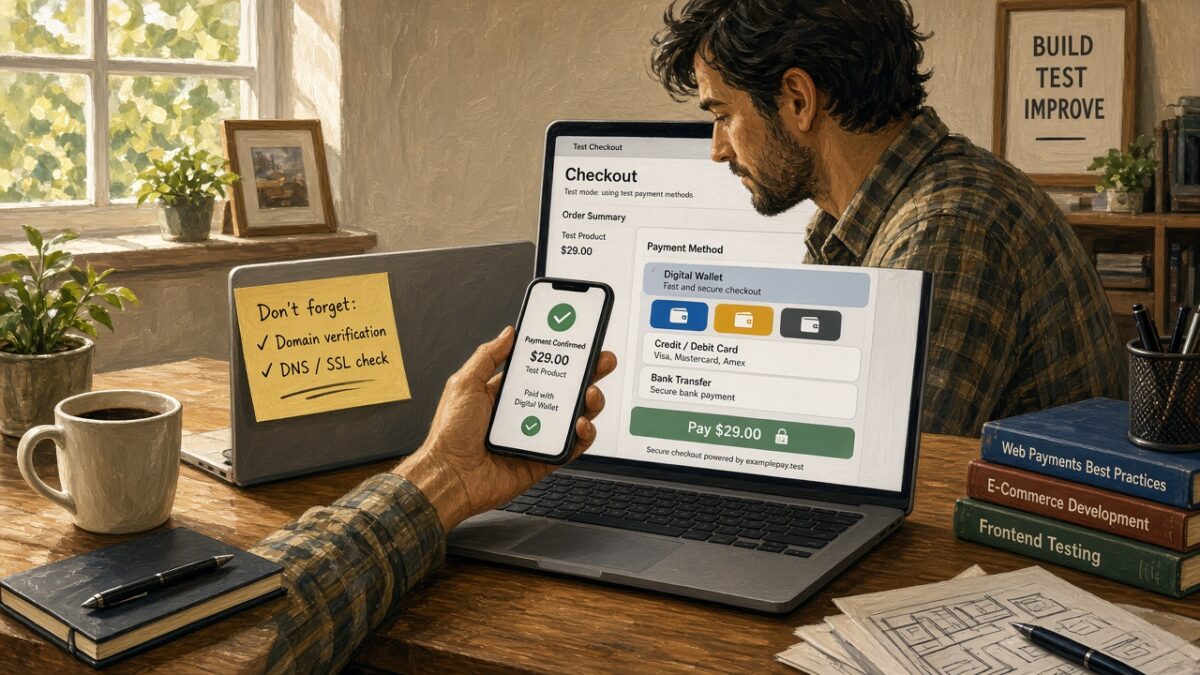
Website owners selling CBD, supplements, telehealth, nicotine, adult, firearms accessories, or other specialty catalogs often fight checkout friction and involuntary declines. Digital wallets can cut typing, surface cards already stored on the device, and keep primary account numbers (PANs) off the merchant's form fields. NMI's Digital Wallet Setup docs describe Apple Pay and Google Pay as ways to accept payments with minimal friction and high conversion rates, and note that wallet payment data arrives in the same payment_token variable used for other Collect.js methods.
Conversion is not the same as approval to process. Acquirers still underwrite the catalog, fulfillment model, chargeback history, and MCC. Adding a wallet button does not rewrite that contract.
What a wallet token actually is
At checkout, the shopper authorizes Apple Pay or Google Pay on a supported device or browser. The wallet returns encrypted or gateway-bound payment credentials instead of a typed card form. The merchant (or the gateway acting for the merchant) submits that payload to the processor. The merchant typically never handles the full PAN in the browser for that wallet path.
Two ideas matter for risk teams:
- Network tokenization. Apple Pay, per Authorize.Net's support materials, uses payment network tokenization. The device presents a tokenized credential that Authorize.Net decrypts when the merchant is enrolled with a payment processing certificate tied to the gateway's Certificate Signing Request (CSR).
- Google Pay auth methods. Google's web tutorial states that the Google Pay API may return cards on file (
PAN_ONLY) or a device token authenticated with a 3-D Secure cryptogram (CRYPTOGRAM_3DS). Those are not interchangeable for fraud and liability analysis.
Treat "wallet" as a checkout UX plus a token type. Do not treat it as a guarantee of issuer liability shift.
Authorize.Net Apple Pay enrollment and opaqueData
Authorize.Net documents Apple Pay under Mobile In-App Transactions and in Merchant Interface support articles such as What is and how to enable Apple Pay with Authorize.net?.
Processor prerequisite (verified list, not MCC eligibility)
Authorize.Net states that Apple Pay uses payment network tokenization. If the processor does not support that tokenization interface (or Authorize.Net does not support the processor's interface), the merchant cannot sign up for Apple Pay through Authorize.Net. The classic support article lists these supported processor connections for Apple Pay:
- Chase Paymentech
- Global Payments
- TSYS
- FDC Nashville
- NAB EPX
- Worldpay (Vantiv Core)
That list is about processor connectivity. It is not a public Authorize.Net promise that every high-risk MCC on those processors may enable wallets. Confirm MCC and wallet enablement with the merchant service provider before promising Apple Pay on a regulated catalog.
Enrollment steps merchants actually take
Per Authorize.Net developer and support docs (Account Owners only for enrollment):
- Create an Apple Merchant Identifier in Apple's developer tools.
- In the Authorize.Net Merchant Interface, open Digital Payment Solutions and sign up for Apple Pay.
- Enter the Apple Merchant ID and generate the Apple CSR from Authorize.Net.
- Submit that Authorize.Net-generated CSR to Apple to create the payment processing certificate. Authorize.Net explicitly says not to generate a replacement CSR through Apple for this step. The certificate lets Authorize.Net decrypt Apple Pay payment data.
Authorize.Net states it does not charge a separate additional fee for Apple Pay. Apple-side fees, if any, are outside that statement. Acquirer interchange and gateway fees still apply to the underlying card network transaction.
Submitting the token
For Apple Pay, Authorize.Net requires a createTransactionRequest that uses opaqueData instead of card number, expiration, track data, or customer-profile card fields. Official constraints include:
- Both opaque parameters must be present.
- No card number, expiration, track data, or 3-D Secure data on the request.
- E-commerce market type (
marketType=0) for card-not-present submissions when that field is used. transactionTypeofauthCaptureTransactionorauthOnlyTransaction.- Payload must be Base64-encoded, decryptable, and belong to the merchant submitting it.
Authorize.Net's official PHP sample for Apple Pay sets dataDescriptor to COMMON.APPLE.INAPP.PAYMENT and places the Base64 blob in dataValue. Tokenization details appear in the Merchant Interface transaction detail view under Tokenization Information.
Authorize.Net Google Pay gateway tokenization
Authorize.Net's Google Pay section on the same in-app feature page, plus support article KA-07952, describes gateway tokenization aligned with Google's tutorial.
Developers configure Google Pay with:
tokenizationType/ typePAYMENT_GATEWAYgatewayset toauthorizenetgatewayMerchantIdset to the Authorize.Net payment gateway ID
After Google returns the payment method token, Authorize.Net instructs merchants to Base64-encode the token blob, then submit createTransactionRequest with opaqueData.dataDescriptor = COMMON.GOOGLE.INAPP.PAYMENT and dataValue = that Base64 string. The same opaqueData constraints apply (no PAN/exp/track/3DS fields on the wallet request; e-commerce market type; auth-only or auth-capture). Processor support for payment network tokenization is again a hard prerequisite.
Authorize.Net notes that Google Pay supports American Express, Discover, JCB, Mastercard, and Visa, and that for authorizations Google Pay supports PAN_ONLY and CRYPTOGRAM_3DS. Merchants may pass billing information for Address Verification Service (AVS) checks. Confirm minimum billing requirements with the merchant service provider.
Google's own web tutorial lists Authorize.net in the payment provider table with gateway authorizenet, and separately lists NMI with gateway gatewayservices.
NMI Collect.js and Payment Component wallets
NMI documents two frontend paths:
- Payment Component (recommended for new work) with the NMI REST API, covering cards, ACH, Apple Pay, and Google Pay (Payment Component).
- Collect.js digital wallet setup for existing Collect.js integrations (Digital Wallet Setup).
On Collect.js, Apple Pay and Google Pay both produce a payment_token so the server-side sale, auth, vault, or subscription call stays structurally consistent with card tokenization. The Payment Component path similarly tokenizes in the browser and sends payment_token to NMI's payments API.
For express checkout, NMI's Payment Component docs say Google Pay transactions work once configured, while Apple Pay additionally requires Apple's domain verification file from the Merchant Portal (Settings > Apple Pay), hosting that file under .well-known, and adding the checkout domain to the allowed domains list.
NMI Collect.js also documents optional billing and shipping contact fields on wallet tokens (name, postal address, phone, email) so AVS-friendly and fulfillment data can ride with the wallet authorization. Recurring Apple Pay attributes exist for subscription and vault flows, including optional up-front sale amounts when registering a plan. Those attributes do not change the need for a properly underwritten MID and recurring disclosure compliance.
Domain verification for Apple Pay on the web
Apple Pay on the web is domain-bound. Apple's Configure Apple Pay on the web instructions require merchants to register each fully qualified domain that will show Apple Pay, download Apple's domain association file, host it where Apple specifies, and click Verify. Apple also requires a merchant identity certificate to authenticate sessions with Apple Pay servers, separate from the payment processing certificate used to encrypt payment data. Apple states that the payment processing certificate expires every 25 months and can be revoked.
Gateway-mediated setups (such as NMI's Merchant Portal flow) still end at the same operational requirement. The verification file must be reachable over HTTPS at the .well-known path Apple or the gateway provides, without a broken redirect chain that blocks Apple's crawler. Register www and apex separately when both host checkout. Register staging hosts separately when they show live Apple Pay buttons.
Authorize.Net's Apple Pay enrollment docs focus on the CSR and opaqueData path for decryptable tokens. For pure web checkout, operators still follow Apple's domain and merchant-identity steps (or the gateway's documented equivalent) so the button can appear and sessions can authenticate. Treat domain verification failures as a launch blocker, not a fraud-tool quirk.
When wallets help fraud and liability outcomes
Wallets can help when they deliver stronger authentication artifacts and when the merchant still runs normal risk controls.
Google's tutorial is explicit. Merchants must apply existing risk checks and controls to Google Pay transactions. Google Pay validation and fraud checks are not intended to replace the merchant's risk management processes. If the integration allows PAN_ONLY, Google says to trigger 3-D Secure for those PAN-only Google Pay transactions the same way the merchant triggers 3-D Secure for ordinary card transactions.
Google's payment data cryptography materials distinguish:
PAN_ONLY. Decrypted payload resembles a card PAN and expiry without a device cryptogram. Liability posture looks closer to a standard card-not-present PAN auth unless the merchant adds 3-D Secure or other controls.CRYPTOGRAM_3DS. Payload includes a cryptogram and may include aneciIndicator. Google's table maps certain ECI values to issuer versus merchant/acquirer liability for Visa and Mastercard device-token transactions. Merchants must passeciIndicatorunchanged on authorization when present.
Apple Pay's device cryptogram model is commonly associated with network token credentials rather than a typed PAN, which is why Authorize.Net frames Apple Pay as payment network tokenization. Exact dispute liability still depends on network rules, region, authentication evidence on the auth message, and the acquirer's processing path. Do not hard-code a universal "Apple Pay equals liability shift" rule in storefront logic.
Authorize.Net's wallet opaqueData rules also say merchants cannot include 3-D Secure data on those Apple Pay or Google Pay createTransaction requests. That means any 3-D Secure strategy for Google PAN_ONLY must be designed with the gateway and fraud stack before go-live, not bolted onto the opaqueData fields Authorize.Net forbids.
When wallets hurt scores, ops, or underwriting optics
Wallets can also create false comfort.
- PAN-only Google Pay without step-up. Accepting
PAN_ONLYwithout the same 3-D Secure policy used for cards can leave the merchant with card-not-present risk while the UI looks "wallet secure." - Missing AVS or billing fields. Authorize.Net notes billing can be passed for AVS. NMI exposes billing contact fields on wallet tokens. If the checkout skips address collection that the fraud rules expect, automated scores can worsen even though the shopper used a wallet.
- Velocity and friendly fraud still exist. Tokenization does not stop "item not received," subscription remorse, or stolen-device misuse. Network dispute programs still count against the MID.
- Processor or tokenization gaps. On Authorize.Net, unsupported processor tokenization means Apple Pay or Google Pay simply cannot be enabled through that gateway path, regardless of how polished the button looks in a theme demo.
- MCC and vertical mismatch. Nothing in the cited Authorize.Net or NMI wallet docs grants CBD, nutraceutical, telehealth, or other specialty catalogs a special wallet eligibility carve-out. Presenting Apple Pay on an unapproved catalog remains an underwriting and compliance problem, not a frontend problem.
Practical build checklist for high-risk operators
- Confirm the MID, MCC, and processor path with the merchant service provider before promising wallet buttons in marketing.
- On Authorize.Net, verify the processor appears on the supported Apple Pay list (or equivalent current support matrix), enroll via Digital Payment Solutions, and use the Authorize.Net CSR for Apple's payment processing certificate.
- On Authorize.Net Google Pay, set gateway
authorizenet, use the payment gateway ID, Base64-encode the token, and submitCOMMON.GOOGLE.INAPP.PAYMENT. - On NMI, prefer Payment Component for new builds; for Collect.js, configure wallet fields and host Apple's domain verification file from Settings > Apple Pay.
- Register and verify every checkout FQDN Apple will see. Keep the association file on HTTPS without blocking redirects.
- Decide explicitly whether Google Pay may return
PAN_ONLY,CRYPTOGRAM_3DS, or both, after confirming processor support for device tokens. - Keep fraud rules, AVS, velocity limits, fulfillment SLAs, and chargeback playbooks active on wallet orders.
- Reconcile wallet transactions in gateway reporting (Authorize.Net Tokenization Information; NMI sale responses keyed by
payment_token) so support teams can distinguish wallet auth failures from ordinary card declines.
Bottom line for regulated ecommerce
Apple Pay and Google Pay on Authorize.Net and NMI are token pipelines with documented enrollment, domain, and opaqueData or payment_token rules. They can raise conversion and, when they deliver cryptogram-backed device tokens with the right ECI handling, can improve authentication posture. They do not erase high-risk underwriting, MCC limits, or dispute ratios. Build the wallet path as a verified integration project, then keep the same risk stack that protects the rest of the catalog.
Sources
- Authorize.Net Mobile In-App Transactions (Apple Pay and Google Pay)
- Authorize.Net support. What is and how to enable Apple Pay (classic)
- Authorize.Net support KA-07952 Google Pay transactions
- Authorize.Net sample create-an-apple-pay-transaction.php (<code>COMMON.APPLE.INAPP.PAYMENT</code>)
- NMI Digital Wallet Setup (Collect.js)
- NMI Payment Component (Apple Pay and Google Pay)
- Apple. Configure Apple Pay on the web
- Google Pay web tutorial (gateway table, PAN_ONLY, CRYPTOGRAM_3DS, risk guidance)