
By E-commerce 4 Internet Marketers Editorial
Explainer. This article translates the Federal Trade Commission's Health Products Compliance Guidance into operational checklist items for supplement and other health-product ecommerce teams. The guidance updates and replaces the 1998 Dietary Supplements: An Advertising Guide for Industry. FTC staff say it is business guidance only and does not have the force or effect of law. Facts below stay inside that document. This is not legal advice. Confirm live site claims with counsel.
Why this guidance matters for ecommerce storefronts
FTC advertising law for health-related products rests on two principles: advertising must be truthful and not misleading, and advertisers must have adequate substantiation for all objective product claims before disseminating an ad. For claims about the health benefits or safety of foods, dietary supplements, drugs, and other health-related products, the agency generally requires substantiation in the form of competent and reliable scientific evidence.
For website owners and developers selling supplements online, "advertising" is broader than paid search creatives. The guidance treats as advertising statements or depictions on packaging and labeling; promotional materials; internet and other digital content; social media and influencer marketing; press releases and media appearances; trade shows; and promotion through healthcare practitioners or other intermediaries. Product detail pages, landing pages, cart upsells, email flows, and UGC embeds sit inside that frame.
Anyone who participates directly in marketing or who has authority to control those practices has an obligation to present claims truthfully and to check the adequacy of support. FTC has taken action not just against product marketers, but also, in appropriate circumstances, against individual owners and officers, ad agencies, distributors, retailers, catalog companies, infomercial producers, expert endorsers, and others engaged in deceptive marketing.
Landing page checklist (claim meaning and disclosures)
Map express and implied claims from the whole page
Marketers must ensure that express claims are accurate. They are equally responsible for claims suggested or reasonably implied. FTC focuses on the consumer's understanding, not the marketer's intent. Evaluate each page as a whole for the "net impression" from text, product name, charts, graphs, and other images. When an ad lends itself to more than one reasonable interpretation, the advertiser must substantiate each interpretation.
Checklist items for landing and product pages:
- Inventory every benefit, safety, and "proof" statement in the hero, bullets, FAQ, and schema copy.
- Review product names, badge art, lab-coat imagery, and chart placements for implied clinical or disease claims even when the body copy stays softer.
- If structure/function wording sits next to disease imagery or seasonal cold cues, treat the likely disease implication as a claim that needs its own substantiation.
- Do not assume a structure/function label category under FDA law changes the FTC analysis. The guidance states FTC follows the same basic steps for health-related claims regardless of FDA claim category.
Disclose material limits clearly and conspicuously
An ad can be deceptive for what it fails to say. If the page would be misleading without key qualifying information (significant limitations on an advertised health benefit, or significant safety risks), that information must be disclosed. Disclosures must be clear and conspicuous: difficult to miss and easily understandable. In social media, the internet, and other interactive media, the disclosure should be unavoidable. Disclosures made through hyperlinks are avoidable. A disclosure should not be contradicted or mitigated by, or inconsistent with, anything else in the ad.
Vague qualifiers such as "may," "helps," "promising," "preliminary," "initial," or "pilot" are often inadequate to communicate scientific limits. A fine-print footer, a Terms and Conditions contradiction, or a "for entertainment purposes only" line that directly conflicts with an efficacy claim is not an effective cure.
Landing-page checklist items:
- Place material limitations next to the claim they qualify, in a size, contrast, and location that ordinary users notice.
- Avoid burying safety or study-limit facts behind expandable legal accordions or linked policy pages alone.
- If a claim and a disclaimer directly contradict each other, rewrite the claim. Do not rely on the disclaimer to cancel it.
- If an effective disclosure is not possible, modify or drop the claim.
Testimonials checklist
Advertisers should not make claims through consumer testimonials or expert endorsements that would be deceptive or could not be substantiated if made directly. It is not enough that a testimonial is an honest opinion or experience. Advertisers must also have appropriate scientific evidence for the underlying implied claim that the product is effective and will work for buyers as it did for the endorser.
Testimonials that report results more dramatic than users can generally expect are likely to be deceptive. Statements such as "Results not typical" do not cure that deception. Those testimonials should be accompanied by a clear and conspicuous disclosure of the results a typical consumer can actually expect.
Expert endorsers must have appropriate qualifications and must have conducted an examination or testing of the product generally recognized in the field as sufficient to support the endorsement. Any material connection between an endorser and the advertiser (a connection consumers would not reasonably expect that could affect weight or credibility) must be clearly and conspicuously disclosed.
Testimonials checklist items:
- Do not publish "it cured my insomnia / reflux / joint pain" quotes unless competent and reliable scientific evidence supports the same claim if you made it in first-party copy.
- For atypical weight-loss or outcome stories, disclose typical study results next to the quote in prominent type, not with a vague "results not typical" footnote.
- Disclose paid blogger, influencer, affiliate, employee, and officer relationships on the same page module as the endorsement.
- Do not overstate expert credentials or imply a medical specialty the endorser does not hold.
- Treat sponsored reviews and exclusive book mentions as advertising that needs the same substantiation and connection disclosure.
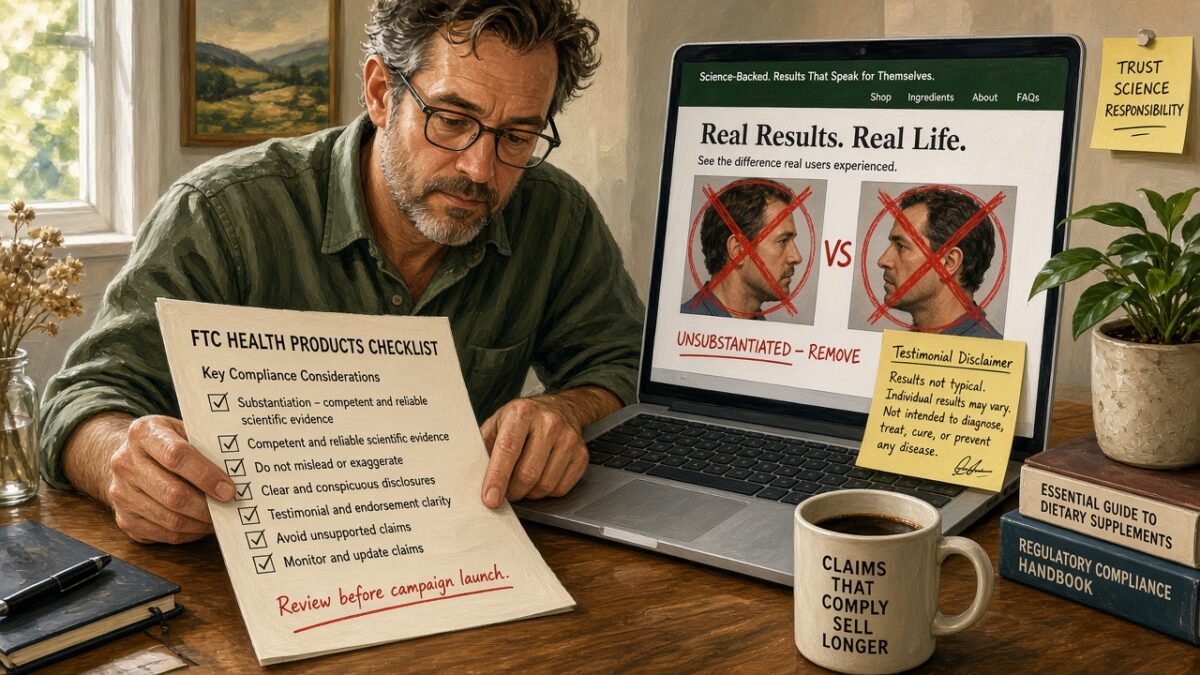
Before-and-after creative checklist
The guidance treats images as claim carriers. Example patterns include lab imagery that implies clinical proof, straw-and-sneeze graphics that imply infection protection, and before-and-after pairs that imply dramatic disease improvement even when the caption uses structure/function wording.
Before-and-after checklist items:
- Ask what disease or dramatic outcome a reasonable consumer would take from the pair of photos plus product name and caption.
- Do not use walker-to-dancing or similar transformations to imply arthritis cure or comparable disease relief without substantiation for that implied claim.
- Match any numeric outcome claim in the caption to study results that are statistically significant, clinically meaningful, and relevant to the marketed product, dose, formulation, and audience.
- Disclose diet, exercise, or other protocol conditions that were required for the depicted or studied results when those conditions are material.
- Keep typical-results disclosures adjacent to the creative, not in a distant footer.
Substantiation checklist before you ship the page
Health-related efficacy and safety claims generally need competent and reliable scientific evidence. The guidance defines that standard, in substance, as tests, analyses, research, or studies conducted and evaluated objectively by relevant experts and generally accepted to yield accurate and reliable results, and sufficient in quality and quantity in light of the entire body of relevant evidence.
As a general matter, substantiation of health-related benefits will need randomized, controlled human clinical testing. Anecdotal consumer experiences, customer satisfaction surveys, and a practitioner's individual patient observations are never sufficient to substantiate health-product effects. Animal and in vitro studies alone are not enough when human research is feasible and expected. Advertisers must have at least the level of support they claim to have ("clinically proven," "scientists now agree," "NIH research," and similar establishment claims).
Substantiation checklist items:
- Match the claim on the page to the exact product, dose, formulation, route, and population studied.
- Prefer well-controlled human clinical evidence over ingredient lore, abstracts alone, or selectively reported post hoc subgroup wins.
- Weigh the totality of evidence, including contrary studies, not only the favorable ones.
- Do not treat the DSHEA labeling disclaimer ("not evaluated by FDA" / "not intended to diagnose, treat, cure, or prevent any disease") as a cure for an otherwise deceptive advertising claim. The guidance states DSHEA did not amend the FTC Act and that the disclaimer will not cure deception about health-related benefits.
- Do not mischaracterize FDA review, authorization, or approval status in banners or trust badges.
How teams should use this on a live catalog
Run the three checklists against every module that ships with a supplement offer: landing heroes, PDP claim stacks, testimonial carousels, before-and-after galleries, influencer embeds, and FAQ schema. Payment and underwriting partners often ask for the same claim inventory when supplement catalogs appear in disputes or MID reviews.
This explainer stays inside FTC's published Health Products Compliance Guidance. It does not invent safe-harbor wording, fine schedules, or case outcomes beyond what that guidance states. Counsel should review live promotional materials against the guidance and related FTC materials.