
By E-commerce 4 Internet Marketers Editorial
Explainer. This article maps federal Gun Control Act requirements that website owners and developers selling firearms online must design around: shipment to a Federal firearms licensee (FFL) in the buyer’s state, ATF Form 4473 and National Instant Criminal Background Check System (NICS) work at the receiving dealer, and federal age floors that differ for rifles and shotguns versus other firearms. Primary sources are 27 CFR 478.102, 27 CFR 478.99, related eCFR sections on Forms 4473 and licensee transfers, the Bureau of Alcohol, Tobacco, Firearms and Explosives (ATF) Federal Firearms Licensee Quick Reference and Best Practices Guide, and ATF Firearms Questions and Answers entries on interstate and non-over-the-counter sales. This is not legal advice. State and local rules vary and were not inventoried here. Confirm live operations with counsel and the receiving FFL.
Why online checkout is not the handoff
For a licensed ecommerce seller, the cart and payment capture do not complete the federal transfer to an unlicensed buyer. Under 27 CFR 478.99(a), a licensee generally may not sell or deliver a firearm to a nonlicensee who does not reside in the state where the licensee’s premises are located. ATF’s Q&A on sales to out-of-state nonlicensees states the usual path: ship the firearm to a licensee in the purchaser’s state of residence, and have the purchaser take delivery from that licensee. ATF’s FFL Quick Reference Guide says the same in operational terms. The selling FFL’s acquisition and disposition (A&D) record reflects the transfer to the out-of-state FFL, not to the end customer. The receiving FFL owns Form 4473 and the NICS check.
That design is what online firearm storefronts must encode in shipping, dealer-locator, and order-status flows. Direct residential delivery of a firearm to an unlicensed out-of-state buyer is not the federal model for ordinary NICS-required sales.
FFL-to-FFL shipment before the customer walks in
Transfers between licensees follow 27 CFR 478.94 and the Form 4473 rule in 27 CFR 478.124(a). Form 4473 is not used for a disposition to another licensed importer, manufacturer, or dealer. The transferor must verify the transferee’s identity and licensed status, typically by obtaining a certified copy of the receiving license (ATF’s guide notes mail, email, or fax are acceptable for that copy) and by recording the disposition in A&D records under the applicable recordkeeping sections. ATF encourages FFL eZ Check before shipping.
Ecommerce implications for sellers and developers:
- Collect a valid receiving-FFL selection before labeling the package as ready to ship.
- Store the receiving licensee’s name and license number for A&D disposition entries.
- Do not treat the remote buyer’s checkout identity as a completed Form 4473 for the shipping FFL.
- Expect transfer fees and timing at the receiving shop to be local commercial terms. Federal rules do not set a nationwide transfer-fee schedule in the sections cited here.
Form 4473 and NICS happen at the receiving dealer
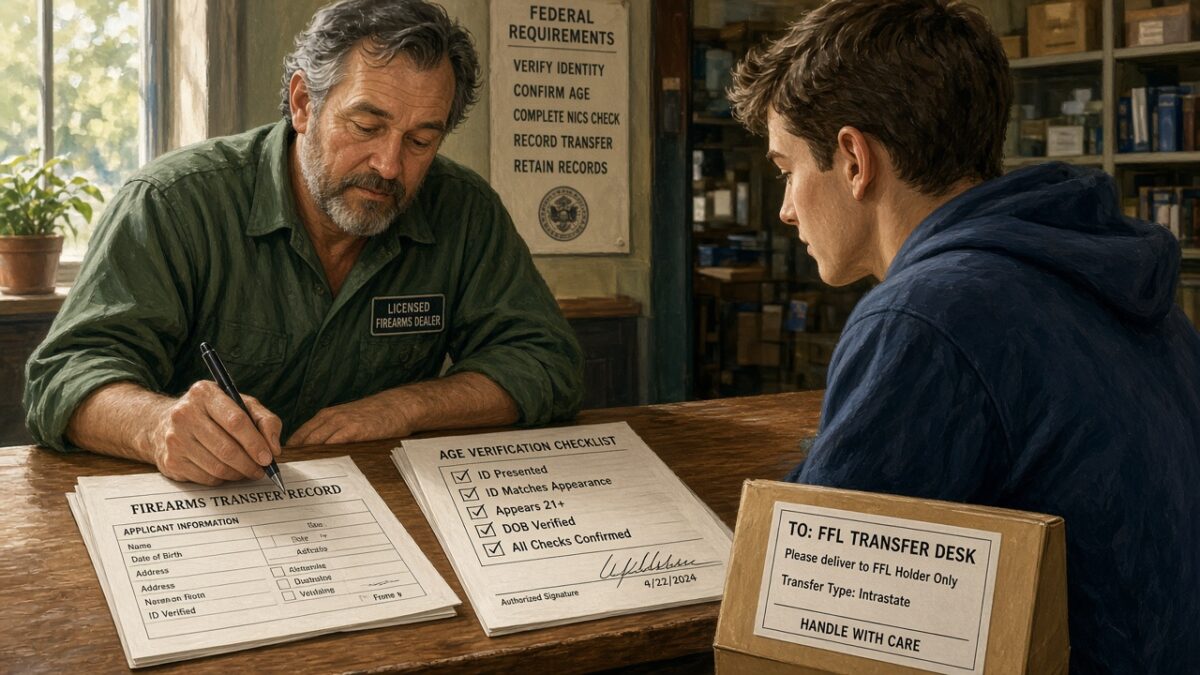
When the receiving FFL transfers the firearm to the nonlicensee customer, 27 CFR 478.124 requires a Firearms Transaction Record, Form 4473, and 27 CFR 478.102 requires a NICS contact before completion (unless a listed exception applies). ATF’s FFL guide states that licensees must obtain a completed Form 4473 for every transfer to a nonlicensee (with narrow exceptions such as licensee-to-licensee transfers), must verify identity from an identification document, and may transfer only to the person named on that Form 4473, not to a spouse or other representative.
Under 478.102(a), before completing the transfer the licensee must:
- Contact NICS.
- Verify the transferee’s identity by examining the identification document as required in 478.124(c).
- Receive a NICS response that allows the transfer to proceed, or wait through the investigatory period when NICS has not yet answered with Proceed or Denied.
NICS outcomes in the regulation include a “Proceed” notification with a unique identification number. If NICS does not give Proceed, the licensee generally must not transfer for three business days (days on which State offices are open). After that window, if NICS has not provided a Denied notification, the licensee may proceed unless the under-21 rules in 478.102(a)(3)(iii) apply. That paragraph adds, through September 30, 2032, an extended investigatory period of up to ten business days total when NICS notifies the licensee within three business days that cause exists for further investigation of a possibly disqualifying juvenile record for a transferee under 21.
478.102(c) limits reliance on a NICS check to a single transaction and to no more than 30 calendar days from the date NICS was initially contacted. If the customer does not complete the transfer within that period, the receiving FFL must initiate a new NICS check.
Some states act as NICS points of contact. 478.102 and ATF’s guide recognize state transaction numbers in those POC arrangements. Storefront copy that says “background check already done online at checkout” is misleading for ordinary NICS-required transfers. The check that matters for release of the firearm is the one the receiving FFL runs against the Form 4473.
When a seller cannot skip the in-person handoff
ATF’s Q&A on transfers to nonlicensed persons who do not appear in person states that, assuming other federal and state law is satisfied, a licensee may transfer to a nonlicensed person who does not appear at the premises only when a background check is not required and both parties reside in the same state (for example, certain NICS-alternative permit transfers under 18 U.S.C. 922(c), 27 CFR 478.96(b), and ATF Procedure 2013-2). The same Q&A states that in any transaction where a NICS check is required, the firearm must be sold over the counter.
27 CFR 478.96(b) covers limited same-state sales of firearms not subject to 478.102(a) to nonlicensees who do not appear in person, with Form 4473, chief law enforcement officer notice, and a seven-day delay after return-receipt evidence. That is not the default path for a typical ecommerce order that still needs NICS.
Separately, 478.96(c) and 478.99(a) allow an over-the-counter sale of a rifle or shotgun to a nonresident who meets the licensee in person, with Form 4473, NICS compliance under 478.102, and compliance with the legal conditions of sale in both states. Frames and receivers not configured as a complete rifle or shotgun do not get that nonresident OTC long-gun path under ATF’s FFL guide. Ecommerce “ship to my door across state lines” is still the wrong mental model for most catalog sales.
Federal age floors for long guns versus other firearms
27 CFR 478.99(b) sets the federal floors for licensee sales and deliveries:
- No firearm or ammunition to anyone the licensee knows or has reasonable cause to believe is less than 18 years of age.
- No firearm other than a shotgun or rifle (and no ammunition other than shotgun or rifle ammunition) to anyone the licensee knows or has reasonable cause to believe is less than 21 years of age.
ATF’s FFL Quick Reference Guide restates those floors and adds practical notes ecommerce catalogs often miss:
- If state law or local ordinances set a higher minimum age, the licensee must observe the higher age.
- A firearm frame or receiver is not a rifle or shotgun and may not be sold or transferred to a person less than 21 years of age.
- Interchangeable rifle/handgun ammunition may be sold to a buyer at least 18 if the licensee is satisfied it will be used in a rifle.
Age gating on a product detail page should follow firearm type (complete rifle/shotgun versus handgun, frame, or receiver), not marketing labels alone. Because this article does not verify state-by-state age increases, waiting periods, or permit alternatives, storefronts that sell into multiple states need counsel and current state materials such as ATF’s State Laws and Published Ordinances compilation rather than a single federal age banner.
Checkout and ops checklist for high-risk firearm catalogs
Map the federal sequence into product, cart, and fulfillment modules:
- Require FFL selection (or equivalent dealer assignment) before shipping a firearm to an out-of-state nonlicensee buyer.
- Ship licensee-to-licensee with license verification and A&D entries that name the receiving FFL.
- Tell customers that Form 4473, ID examination, and NICS (or state POC) happen in person at the receiving dealer before release.
Payment processors, carriers, and marketplaces add their own contracts. Those are outside the federal sections verified for this explainer.
What this explainer does not invent
Facts above stay inside the cited eCFR sections, ATF’s FFL Quick Reference Guide, and ATF Q&A language on interstate and non-over-the-counter transfers. This article does not inventory state waiting periods, state age increases, Brady permit-chart alternatives, carrier firearm-shipping policies, or proposed rulemakings that are not final. Specific ATF Q&A answers used above were confirmed through archived page text and the same statutory and regulatory citations ATF lists on those answers (live atf.gov Q&A fetches returned Access Denied during sourcing). Counsel should review live SKUs, dealer networks, and destination-state rules before launch.
Sources
- 27 CFR 478.102 (NICS sales or deliveries)
- 27 CFR 478.99 (prohibited sales, interstate, age)
- 27 CFR 478.124 (Form 4473)
- 27 CFR 478.96 (out-of-state and mail order sales)
- 27 CFR 478.94 (sales or deliveries between licensees)
- ATF Federal Firearms Licensee Quick Reference and Best Practices Guide
- ATF Firearms Questions and Answers (live index; specific interstate and non-over-the-counter Q&A answers confirmed via archived page text when live atf.gov Q&A fetches returned Access Denied)